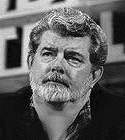
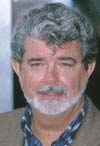
George Lucas - Star Wars
Producer|
Director | Screenwriter
Comprehensive George Lucas, Star Wars site, Biography,
movies, awards, news, and
resource links.
Biography:
George Walton Lucas Jr. was born on May 14,1944 in
Modesto, California...
After surviving a near fatal auto accident George
Lucas immediately enrolled in a local junior college
in a successful attempt to bring his grades up high
enough to be accepted in the University of Southern
California’s film program. He interpreted “film” to
mean “photography,” but once he began his work in
motion pictures he knew it was what he loved.
"It's hard work making movies. It's like
being a doctor: you work long hours, very hard
hours, and it's emotional, tense work. If
you don't really love it, then it ain't worth
it."
George Walton Lucas Jr. was born on May
14,1944 in Modesto, California. He spent his
childhood fascinated with comic books,
especially “Buck Rogers” and “Flash Gordon.” He
spent his teenage years bored with the tedium of
routine school days and teachers. Car racing was
the only excitement that George Lucas was
allowed.
It was his love of car racing that would
dramatically change his life. June 12, 1962,
three days before George Lucas was to graduate from
high school, he was involved in a serious
accident. George Lucas was gravely injured when his
Fiat Biancina was struck broadside by another
car (a fellow student at Downey High School,
Modesto California) and was sent rolling toward
a walnut tree at sixty miles per hour.
His seat belt snapped and he was flung
from the car which, a split second later,
collided with such force that it moved the tree
two feet, roots and all. If the seat belt had
worked, he would have been killed instantly.
“You can’t have that kind of experience and not
feel that there must be a reason why you’re
here,” George Lucas has said. “I realized I should be
spending my time trying to figure out what that
reason is and trying to fulfill it.”
He immediately enrolled in a local junior
college in a successful attempt to bring his grades up high enough to
be accepted in the University of Southern California’s film school. He
interpreted “film” to mean “photography,” but
once he began his work in motion pictures he
knew itwas what he loved. He became
determined to succeed in this competitive
environment. George Lucas differed greatly from much of
the rest of the ‘60s film school generation
that his love affair with movies began only
after he entered college. “I only went to movies
to chase girls,” George Lucas commented of his youth in
Modesto. “It took years before good movies got
to my town – and foreign films?
Never.”
George Lucas’ student work reflected the pop
culture obsessions of his youth: 1:42:08,
a racing mini-epic, and The
Emperor, about a disc jockey named Emperor
Hudson, were signature student works, which George Lucas would later revisit
and build upon in American Graffiti.
In 1966, George Lucas was hired as a teaching
assistant
After graduating from USC in 1966, George
Lucas
was hired as a teaching assistant assigned to
train cameramen for the U.S. Military. It was
during this time that George Lucas found an opportunity
to shoot THX
1138:4EB – an abstract, Orwellian science
fiction short which went on to win several major student awards and
which would ultimately be
adapted to the big screen for George Lucas’ first
studio feature. In 1967, George Lucas re-enrolled as a USC graduate student. In the same year, he was
selected as one of four student filmmakers from
the USC and UCLA film programs to make a “behind
the scenes” documentary about the making of McKenna’s
Gold. On the strength of his many student
awards, George Lucas won USC’s annual scholarship to
become a production apprentice at Warner
Brothers.
George Lucas might be driven by grand ambitions,
he was financially
cautious
Along with his high school car accident
and the decision to attend USC; the
apprenticeship turned out to be another
life-altering event. Warner Bros. was in turmoil
thanks to its recent purchase by Seven Arts and
the resulting exodus of founding production
chief Jack Warner. There was only one film in
production on the entire lot: a musical starring
Fred Astair and Petula Clark entitled Finian’s
Rainbow, which was being directed by a
27-year-old UCLA graduate,
Francis Coppola. It
was due to this that the two met and became life
long friends despite their opposite
personalities. George Lucas was physically slight,
Coppola was large and flamboyant; while George
Lucas
might be driven by grand ambitions, he was
financially cautious while Coppola was reckless
with money; where George Lucas was quiet and reserved,
Coppola reveled in the
spotlight.
During his
apprenticeship, Coppola made George Lucas an offer he couldn’t refuse
During his apprenticeship, Coppola made
George Lucas an offer he couldn’t refuse. George
Lucas would
become a paid assistant on both Finian’s
Rainbow and TheRain
People, the artier road movie that Coppola
was prepping on the side, and Coppola would help
nurture George Lucas’ newest baby, a feature length
version of THX.
When Finian’s
Rainbow wrapped, Coppola made good on his
promise and talked Warner Bros. into signing
George Lucas to develop his THX
feature. George Lucas continued to work on both The Rain
People with Coppola during the day and work
on THX by
night.
In 1969, when The Rain
People was completed, Coppola decided to
move on to the next phase of his plan to take over the film industry.
He went on a celebrated equipment-buying spree during his trip to
Europe, which, by some accounts, left the more conservative George
Lucas
terrified. Once back in the U.S., Coppola and George Lucas conceived a plan
to rent a warehouse in San Francisco, CA and turn it
into an independent studio called American
Zoetrope, after one of the earliest motion
picture devices.
*The
FilmMakers Film Fund
will finance the production of all future film projects. The projects will be
made up of undiscovered Emerging artists in film including: screenwriters,
directors, producers, actors, cinematographers, music composers, first assistant
directors (AD), art directors, costume designers, production managers
(PM), etc.
Support our
Youth by making a donation to the FilmMakers Film Fund.
Tags: George Lucas, George Lucas
bio, Star Wars, George Lucas biography,
Lucas,
biography, filmography, george lucas resources,
george lucas awards, George Lucas movies,
george lucas films, news,
films in development, films in
post, lucas photos, film director, screenwriter,
producer, filmmaker. links to George Lucas
films, news, George Lucas Star Wars, movie
star wars